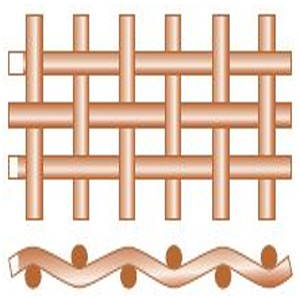
Wire mesh is widely used in various applications The variety of woven wire cloth material and weave designs allow this material to be used in many common and not so common applications such as filters, strainers, baskets, sieves and sorters. Woven wire mesh is the ideal choice for applications that require both precision and strength. This advanced material is available in various alloys, and forms such as rolls, cut pieces, and custom sizes. Weave types include plain, twill, Dutch, twilled Dutch, and reverse Dutch.
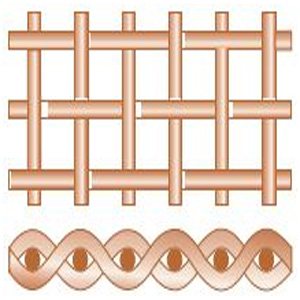
The most common weave, with the same diameter warp and weft wires woven in a simple over and under pattern to create strong and hard mesh for general purpose. The Warp and Weft diameter is usually the same, It produces screens with the same mesh count in both directions.
TWILL WEAVE
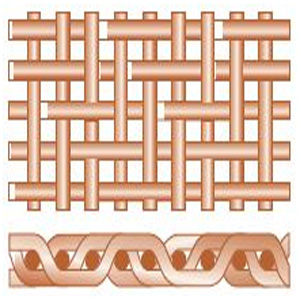
Each Weft wire typically passes over two or more Warp wires and then under two or more , producing square openings. Twill weave can be made from larger-diameter wires than would be possible in plain square weave to obtain greater strength, density, or corrosion resistance.
PLAIN DUTCH WEAVE
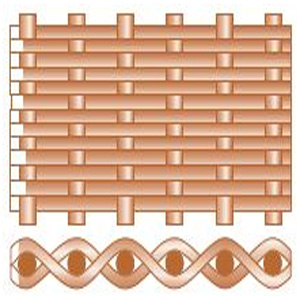
Woven in a plain over and under pattern. A thinner, smaller diameter Weft wire is used; these are driven very close together creating a very tight weave. Dutch weaves do not have a straight-through clear opening as do most Plain weave styles. Instead the weave style creates a tortuous path through which very fine filtration and particle retention can be achieved thus is commonly used for fine liquid and high pressure filetration in the pharmaceutical, petrochemical, aerospace and wastewater teatment facilites as it is very ideal for high flow rates.low pressure loss and high level of mechanical load, Dutch weaves may be specified by “mesh count” or “absolute filter rating.”
REVERSE DUTCH WEAVE
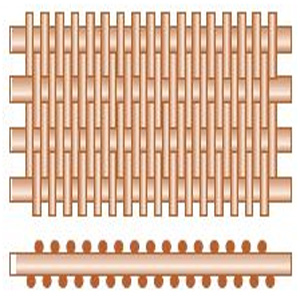
The same weave as Plain Dutch except the warp and shute wires are reversed; i.e., the warp wires have a smaller diameter than the weft wires. The larger weft wires are woven closer together than would usually be seen in a Plain Dutch Weave.It has more load bearing capacity than plain duth weave thus idle for conveyor belts
RECTANGULAR OR “OFF-COUNT” WEAVE
A Plain Weave wire cloth, woven in an over and under pattern with a different number of wires in the warp and shute direction, which yields a rectangular opening wire cloth. Rectangular openings are often used in sifting and sizing operations to increase product “through” capacity with minor sacrifices in accuracy. To reduce material costs, off-count mesh may be substituted for square mesh in some applications that do not require a high level of accuracy. Some wire cloth vendors will substitute off-count wire cloth when certifications are not specified by the manufacturer, e.g. a 90×100 mesh may be substituted for 100×100.
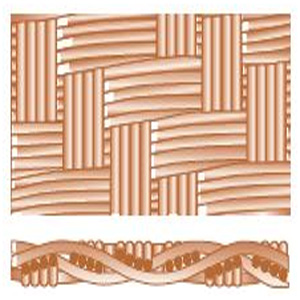
FIVE HEDDLE WEAVE
Usually woven in the Plain Square style, each warp and weft “wire” is composed of a “bunch” or “group” of small diameter wires, which are woven into a finished product making a high weight bearing requirement with small filteration rate, Thus giving advantage over thick wire mesh which we often use to improve the weight bearing capacity which comes with big opening,.